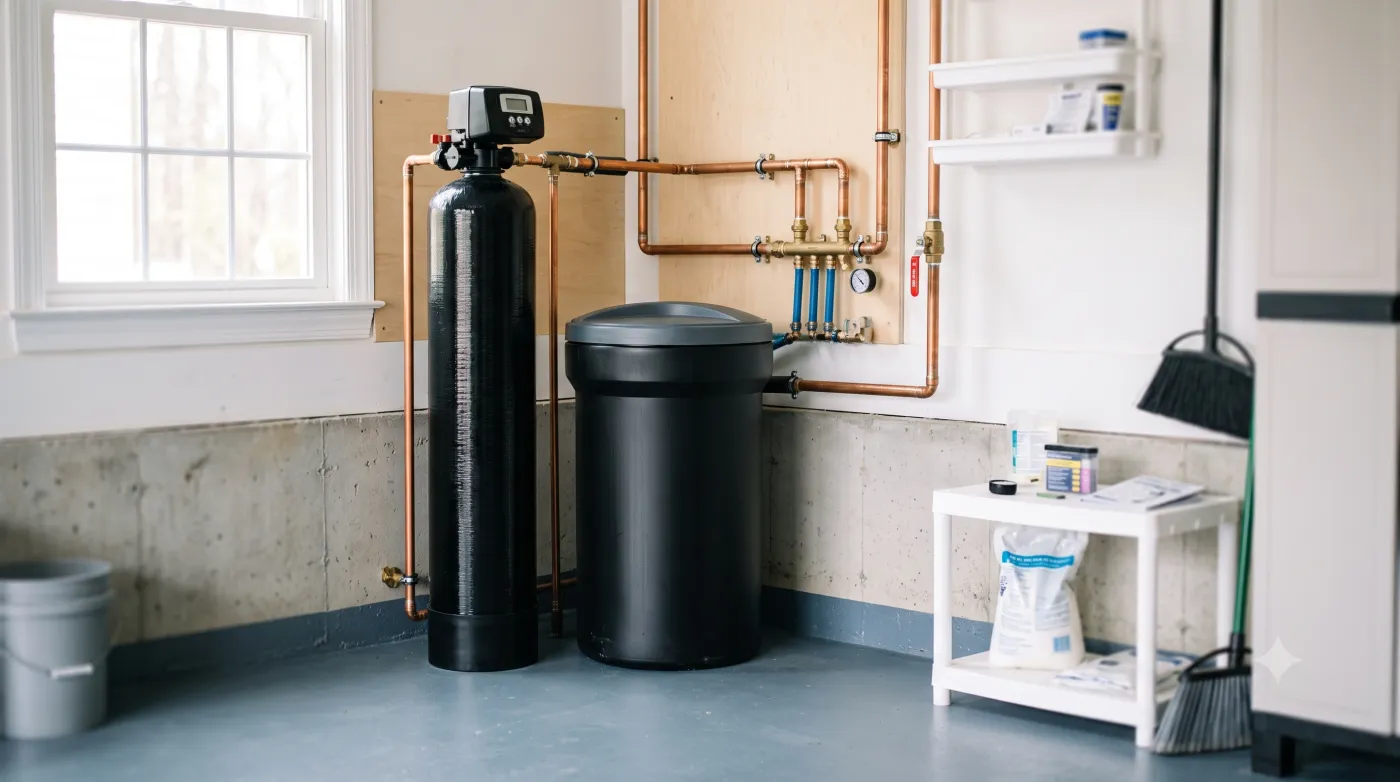
Hard waterHardness (Calcium Carbonate)The concentration of dissolved calcium and magnesium in water. Hard water causes scale buildup in pipes, water heaters, and fixtures.No EPA standard. Soft: <1 gpg. Moderate: 1-7 gpg. Hard: 7-10.5 gpg. Very Hard: >10.5 gpg.Learn more → (dissolved calcium and magnesium) affects 85% of wells. A water softenerWater SoftenerA system that uses ion exchange resin to remove calcium and magnesium (hardness minerals) from water. Prevents scale buildup in pipes, water heaters, and appliances.Learn more → (a salt-based system using ion exchange) is the only proven fix. We compared the top options for well water.
Quick Comparison: Top 4 Water Softeners
| System | Grain Capacity | Iron Handling | Warranty | Price | |
|---|---|---|---|---|---|
| SpringWell SS Our Pick | 32K–80K | 3 ppm | Lifetime | $1,500+ (varies by size) | Check Price |
| SoftPro Elite Best Value | 32K–80K | 2 ppm | 10 years | $700–$1,200 | Check Price |
| Fleck 5600SXT Most Popular | 32K–64K | 2 ppm | 5 years (valve), 10 years (tank) | $600–$900 | Check Price |
| Whirlpool WHES40E Budget Pick | 40K | 1 ppm | 1 year | $400–$550 | Check Price |
Ready to buy? FiltersFast stocks water softeners with free shipping and a 70-day return window.
Shop water softeners at FiltersFast →How We Chose These Softeners
We evaluated each system on grain capacity range, iron handling, salt efficiency, warranty, and 10-year cost including salt and resin[5].
Detailed Reviews
SpringWell SS — Our Pick for Well Water
The SpringWell SS uses upflow brining, which saves salt and extends resin life. It handles iron up to 3 ppm — higher than most softeners. The lifetime warranty is best in class[1].
Who this is for: Well owners who want the best softener with the longest warranty. Good for hard water with light iron. See our full SpringWell system review to compare the softener against their filters and combo setups.
Who should skip this: If iron exceeds 3 ppm, install a dedicated iron filter before any softener.
SoftPro Elite — Best Value
Similar capacity to the SpringWell at a lower price. Good salt efficiency. Slightly less iron handling[2].
Who this is for: Value-conscious well owners with hardness as the primary issue.
Fleck 5600SXT — Most Popular
The Fleck 5600SXT is the most widely installed residential softener valve. Proven reliability. Massive parts availability[3].
Who this is for: DIYers who want a proven system with easy-to-find parts.
Whirlpool WHES40E — Budget Pick
Available at big box stores. Easy to find and install. Trade-off: short warranty and limited iron handling.
Who this is for: Budget-conscious homeowners with moderate hardness and no iron issues.
Check price for Whirlpool WHES40E
How to Size a Softener for Well Water
The formula is: hardness (GPG) × daily gallons × days between regeneration = grain capacity needed.
Example: 20 GPG × 300 gallons/day × 7 days = 42,000 grains. A 48,000-grain unit fits[5].
Most people use about 75 gallons per person per day. Use the table to skip the arithmetic.
| Household | Daily use | 10 GPG water | 20 GPG water | 30 GPG water |
|---|---|---|---|---|
| 1–2 people | 150 gal | 24,000 | 32,000 | 32,000 |
| 3–4 people | 300 gal | 32,000 | 48,000 | 64,000 |
| 5–6 people | 450 gal | 48,000 | 64,000 | 80,000 |
| 7+ people | 600 gal | 64,000 | 80,000 | 80,000+ |
If your well also carries ironIronA naturally occurring mineral found in groundwater. Iron causes orange/rust staining on fixtures and laundry and gives water a metallic taste.EPA Secondary MCL: 0.3 mg/L (ppm)Learn more → (a dissolved metal), add 5 GPG to your hardness number for every 1 ppm of iron before you size. Iron at 2 ppm turns 20 GPG water into 30 GPG water as far as the resin is concerned.
Do not oversize by more than one class. A softener that regenerates too rarely lets the resin bed sit dirty between cycles.
How to find your hardness
- Check your water test. Hardness is reported in GPG or in mg/L. Divide mg/L by 17.1 to get GPG.
- Use a test strip. A $10 strip kit gets you close enough to size a unit.
- Run the numbers. Our water test interpreter converts your report into plain language, and the water test reading guide explains each line.
Salt-Based vs Salt-Free vs Dual-Tank
Three types get sold as "water softeners." Only one of them actually softens water.
| Type | Removes hardness? | Needs salt? | Annual cost | Best for |
|---|---|---|---|---|
| Salt-based ion exchange | Yes | Yes | $50–$100 | Almost every well |
| Salt-free conditioner | No | No | $0–$60 | Scale control only |
| Dual-tank salt-based | Yes | Yes | $60–$120 | Large homes, no downtime |
A salt-free "conditioner" does not remove calcium and magnesium. It changes their structure so they stick to pipes less[4]. Your water will still feel hard, still spot glasses, and still test at the same GPG.
That can be the right choice if scale in the water heater is your only complaint, or if a local ordinance restricts salt discharge. If you want the slippery-water, less-soap, no-spots result people mean by "softened," you need salt-based.
Dual-tank systems keep one tank in service while the other regenerates. Worth it above about 6 people, or if you have a night-shift household where a 2 a.m. regeneration would matter.
What to Look For in a Well Water Softener
- An iron rating that matches your test. This is the number that separates a well softener from a city-water softener. Under 1 ppm is a city spec.
- Upflow brining. It pushes brine through the freshest resin first and uses 30–50% less salt than downflow[6].
- Metered regeneration, not timed. A metered valve regenerates on water used. A timer regenerates on schedule whether you needed it or not, wasting salt and water.
- NSF/ANSI 44 certification. It verifies the capacity claim on the box is real[4].
- 10% crosslink resin. Standard 8% resin degrades faster on well water with any oxidizer present. The upgrade is worth it.
- A bypass valve. You will service this eventually. A bypass makes it a 30-second job.
Signs Your Softener Is Failing
- Soap stops lathering. The first symptom, and usually the earliest warning that the resin is exhausted or fouled.
- Spots return on glassware. Hardness is breaking through between regenerations.
- The brine tank stays full of water. A salt bridge has formed, or the draw is blocked. The unit is cycling without actually regenerating.
- Salt use jumps with no change in habits. Often a stuck valve regenerating far more often than it should.
- Rusty tint after regeneration. Iron has fouled the resin bed. You need an iron filter ahead of the softener.
- Resin beads in the aerator. The distributor screen has failed. The bed is washing into your plumbing.
Resin lasts 10–15 years on clean water. On well water with iron, expect closer to 5–8 unless you pre-filter.
What Hard Water Actually Costs
Hardness is not a health issue. It is an appliance issue, and the meter runs quietly for years. Scale reduces water heater efficiency and shortens the life of anything that heats water[6].
| Scenario | Up-front | What happens over 10 years | 10-year total |
|---|---|---|---|
| Untreated, 20 GPG | $0 | Water heater replaced ~2 years early, higher heating bills, extra soap and detergent, fixtures scaled | $2,800–$4,200 |
| Softener installed | $900 | $75/yr salt, resin still good at year 10 | $1,650 |
The gap is roughly $1,500–$2,500 over a decade, before counting the soap you stop buying. Our treatment cost guide breaks down the whole system budget.
Common Installation Mistakes
- Putting the softener before the iron filter. Iron and sulfur foul resin. Oxidizing filters always go first. See our sulfur filter comparison if you have rotten egg smell too.
- Softening the outside taps. Lawns and gardens do not need it and you will pay for the salt. Plumb hose bibs ahead of the unit.
- Softening the cold kitchen line. Ion exchange adds sodium. Many people leave one cold tap unsoftened for drinking and cooking.
- Setting hardness on the valve without adding for iron. The valve regenerates on the number you program. Understate it and you get breakthrough.
- No drain air gap. The discharge line needs an air gap or you risk siphoning drain water back into the system.
- Skipping the sediment pre-filter. Grit scores the valve seals. A spin-down filter is cheap insurance.
Frequently Asked Questions
What size water softener do I need for well water?
Multiply hardness (GPG) × daily water use × days between regeneration. A family of four with 20 GPG water needs about 42,000–48,000 grains. Add 5 GPG for every 1 ppm of iron before you size[5].
Can a water softener handle iron in well water?
Most handle 1–3 ppm. Above that, iron fouls the resin and shortens its life badly. Install a dedicated iron filter ahead of the softener[5].
How much salt does a water softener use?
40–80 lbs per month, or $50–$100 a year. High-efficiency models with upflow brining use 30–50% less[6].
Do salt-free water softeners work on well water?
They control scale but do not remove hardness. Your water still tests at the same GPG and still feels hard. If you want the softened-water result, you need a salt-based system[4].
Does a water softener remove sulfur smell?
No. Hydrogen sulfide is a dissolved gas and passes straight through ion exchange resin. It also fouls the resin. Treat sulfur first with a sulfur filter.
How long does a water softener last?
The tank and resin last 10–15 years on clean water, closer to 5–8 on well water with iron. Valves often outlast the resin and can be rebuilt.
Is softened water safe to drink?
Yes for most people. Ion exchange adds a small amount of sodium — about 7.5 mg per quart for every 1 GPG removed. If you are on a strict low-sodium diet, leave one cold tap unsoftened or use reverse osmosis for drinking water.
Why is my softener using so much salt?
Usually a valve regenerating too often, a hardness setting entered too high, or a leaking drain line running continuously. Check the drain first — a constant trickle is the most common cause.
Can I install a water softener myself?
Yes with basic plumbing skills. You need a drain with an air gap, a power outlet, and a bypass. Budget 4–6 hours. Professional installation adds $300–$700.
Metered or timed regeneration?
Metered, every time. It regenerates on water actually used, which saves salt and water. Timed valves regenerate on schedule whether the bed needs it or not.
References
- SpringWell Water Systems. "SS Series Water Softener Specifications." 2025.
- SoftPro Water Systems. "Elite Series Softener Specifications." 2025.
- Fleck. "5600SXT Water Softener Valve Specifications." 2025.
- NSF International. "NSF/ANSI 44: Residential Cation Exchange Water Softeners." 2024. https://www.nsf.org
- Water Quality Association. "Choosing a Water Softener." Consumer Guide, 2024. https://wqa.org
- Battelle Memorial Institute. "Benefits of Water Softening." Water Quality Research Foundation, 2009.